PALEONTOLOGY • INSECT BEHAVIOR • TRACE FOSSILS
Ancient Bee Nests Hidden in Fossil Bones
Empty tooth sockets became tiny nurseries in a Caribbean cave, preserving evidence of an unexpected nesting strategy.
ADDED NOVEMBER 2, 2026 • STUDY PUBLISHED DECEMBER 17, 2025
A nest inside another animal’s remains
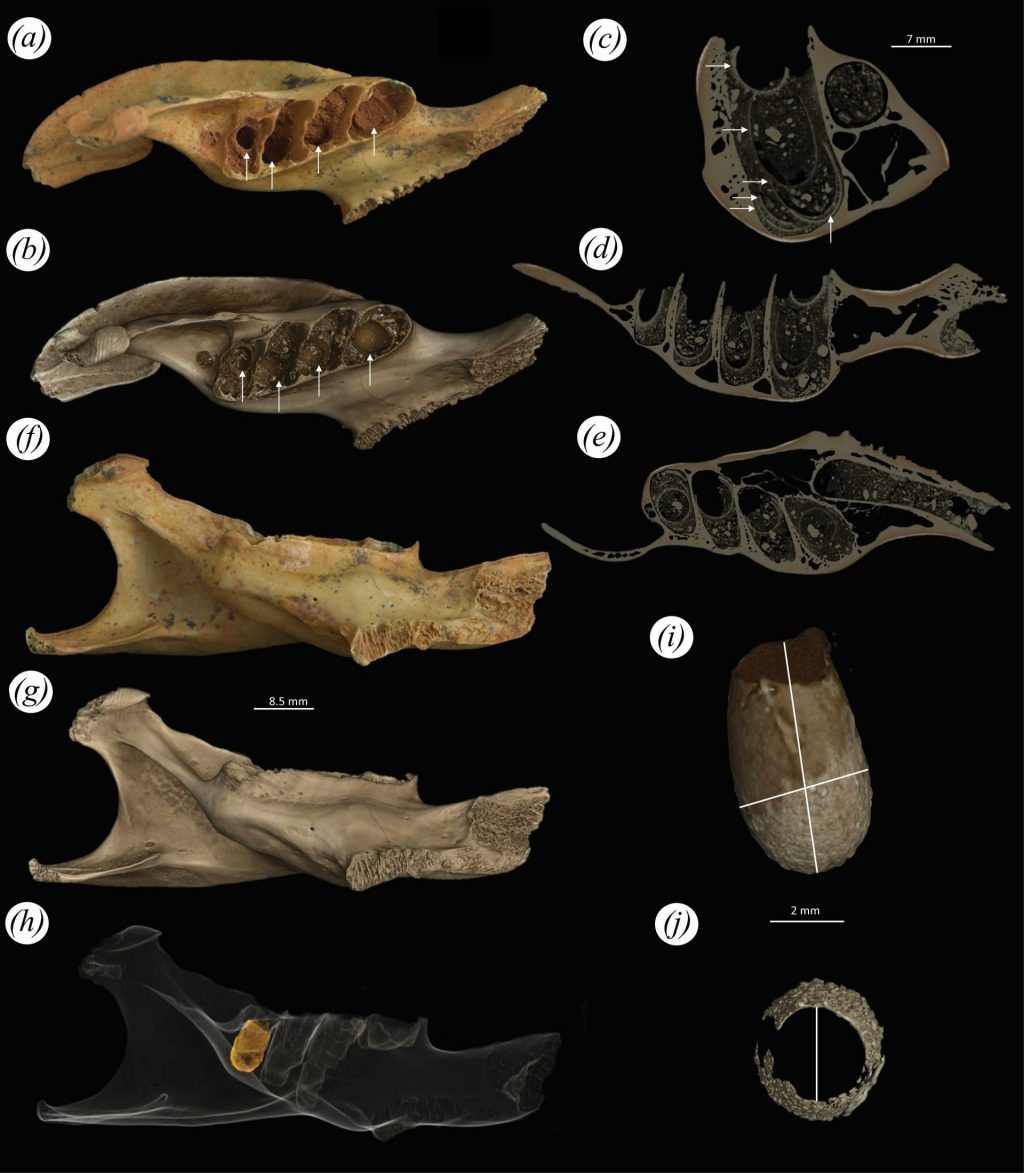
Researchers found brood cells inside mammal bone cavities at Cueva de Mono in the southwestern Dominican Republic, on Hispaniola. The structures occur in tooth sockets, a tooth’s pulp chamber and a vertebral canal. Their shape and smooth, layered lining support identification as nests made by burrowing bees.
What CT scans revealed
The Florida Museum explains that scans revealed repeated nest construction within the same cavity: one tooth socket held six nested cells. Owl predation probably helped accumulate the mammal bones. Limited soil on the surrounding limestone landscape may explain why burrowing bees used sediment inside the cave.
These are interpretations of preserved structures and context. The evidence concerns solitary bee nesting, rather than a honeybee hive or a honey store.
How old are the nests?
The study reports no radiocarbon dates for this cave. It infers a late Quaternary age from the fossil animal assemblage and comparisons with dated material elsewhere on Hispaniola. Bee cells occur in the deposit’s three upper clay layers. Consequently, the widely repeated “20,000 years ago” should not be treated as a directly measured age for these nests.
A name for the trace, not the bee
The authors named the trace fossil Osnidum almontei. The nest architecture suggests a medium-sized burrowing bee, likely in Halictidae. The name classifies the preserved nesting structure; it does not identify a newly discovered bee body species.
The discovery depended on looking twice
The museum’s account describes how a smooth lining caught the researchers’ attention before ordinary fossil cleaning could remove the sediment. An initial wasp-nest interpretation changed after comparison with the linings made by bees. Careful examination turned what might have looked like unwanted dirt into evidence.
Why it belongs in MKP
MKP interpretation: Fossils can record actions as well as anatomy. This example connects vertebrate paleontology, insect biology and imaging—and shows why specimen preparation is itself a scientific decision.
Discussion questions
- How does a trace fossil differ from a preserved animal body?
- What evidence would distinguish a constructed cell from ordinary sediment?
- Why is a geological age inferred from associated fossils different from a direct radiocarbon measurement?
Primary sources
- Viñola-López and colleagues (2025): Trace fossils within mammal remains reveal novel bee nesting behaviour, Royal Society Open Science 12:251748. Includes cave stratigraphy, methods and dating limitations.
- Florida Museum of Natural History: fossil bee nests inside fossil bones, December 2025.