Astronomers have reported strong evidence of a moon-like companion orbiting a brown dwarf roughly 73 light-years away. The discovery is exciting not because scientists have definitively identified a new kind of world, but because the candidate does not fit neatly into the familiar categories of planet and moon.
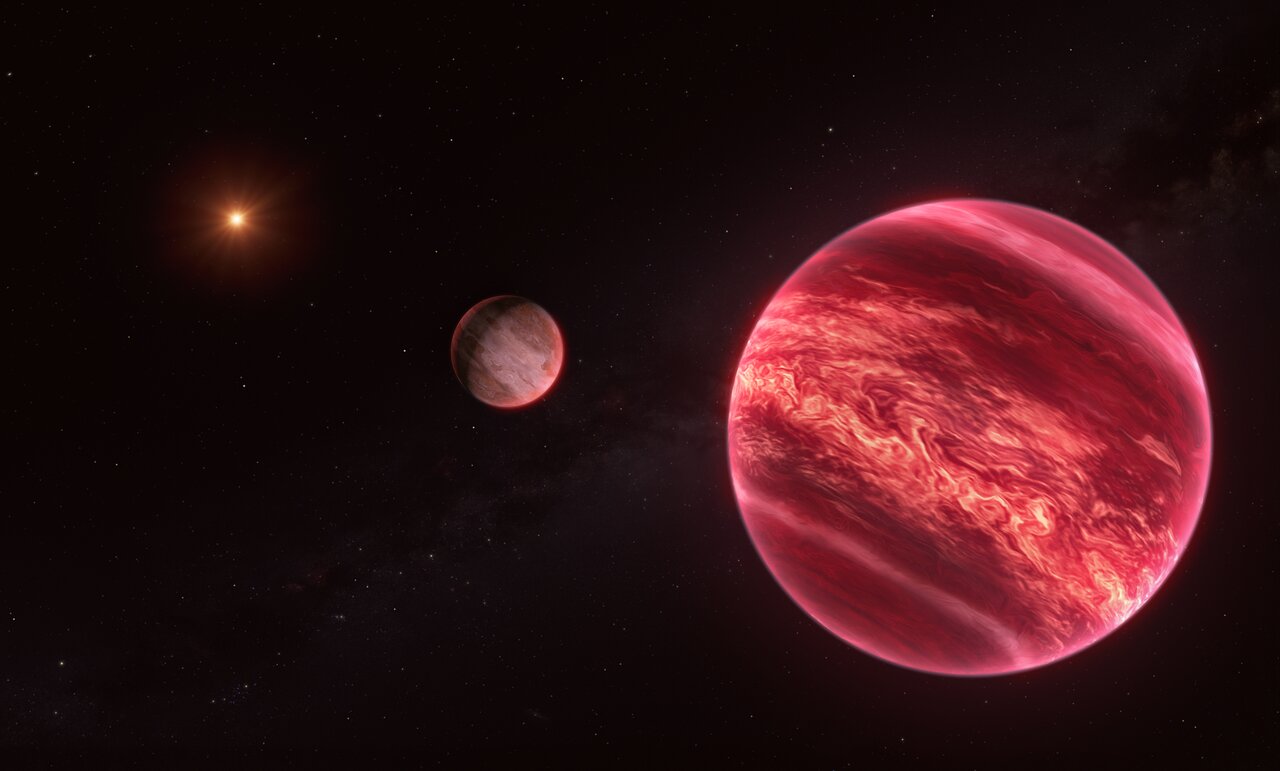
A three-tiered system
CD-35 2722 is a relatively low-mass star, with about 40–50% of the Sun's mass. Circling it is CD-35 2722 B, a brown dwarf about 37 times Jupiter's mass. Brown dwarfs occupy the mass range between conventional giant planets and stars, but cannot sustain ordinary hydrogen fusion as stars do.
Researchers now infer a third body orbiting the brown dwarf itself. Their favored single-companion model suggests a minimum mass of about 0.9 Jupiter masses and an orbit of approximately 170 days. Its actual mass could be higher because the orbital inclination is not yet known. The brown dwarf's much wider orbit around the central star is estimated to take thousands of years and remains incompletely constrained.
How can astronomers find something they cannot see?
The newly proposed satellite has not been directly photographed. Instead, astronomers used the CRIRES+ spectrograph on the European Southern Observatory's Very Large Telescope to measure tiny shifts in the brown dwarf's spectrum. As an unseen companion pulls its host toward and away from us, the Doppler effect shifts its light slightly toward blue and red. This is the radial-velocity method.
The team monitored the brown dwarf between October 2023 and February 2026 and analysed 23 usable observing epochs. The data contain a strong periodic signal close to 170 days. It is a notable demonstration that the method can be used on a brown dwarf, rather than just on a star, to search for companions.
Planet, moon, or something in between?
A giant planet is often described by its mass and its relationship to a star. A moon, in everyday Solar System language, orbits a planet. The new candidate has planet-like mass but orbits a brown dwarf—an object that is neither a conventional planet nor a hydrogen-burning star.
The researchers therefore use the more neutral word exosatellite: a satellite outside our Solar System. Classification depends not only on size and mass but also on orbital context and possibly how the body formed. The exact boundary between an exomoon and other satellite-like companions is not universally defined.
Why the discovery matters
- Broader satellite searches: Spectroscopy may reveal unseen companions around directly imaged brown dwarfs and giant planets.
- How systems form: A large companion around a brown dwarf could test models of disk formation, capture, and orbital evolution.
- Better scientific categories: Systems unlike our own force astronomers to clarify the definitions we use for planets, stars, and satellites.
What we still do not know
No direct image, atmospheric composition, surface conditions, or evidence of life has been reported for the companion. Its true mass and precise orbital geometry are uncertain. Most importantly, continued observations are required to establish that the signal indeed traces a persistent orbiting object.
Question for MKP readers
If a Jupiter-mass world circles a brown dwarf, should scientists classify it by its mass, its orbit, or its formation history? Could two worlds with similar physical properties deserve different names simply because they orbit different kinds of hosts?
Primary research and further reading
- Hoy, K., et al. (2026), Planetary-Mass Exosatellite Detected Around a Star’s Substellar Companion, Nature. DOI: 10.1038/s41586-026-10751-w.
- Research paper hosted by ESO (PDF).
- European Southern Observatory — New ‘exomoon’ detection challenges cosmic labels (July 22, 2026).
- ESO animation — How the candidate was detected via its host's wobble.
- Futura — The popular-science article that inspired this explainer (October 12, 2026).
Discuss this research
What would you call this candidate world? Suggest a question or follow-up through the MKP discussion page.
Join the Discussion