BLACK HOLES • RADIO ASTRONOMY • ENERGY
Cygnus X-1: Measuring the Power of “Dancing” Jets
A companion star’s wind becomes a tool for measuring a black hole system’s outflow.
ADDED OCTOBER 28, 2026 • STUDY PUBLISHED APRIL 16, 2026
The finding
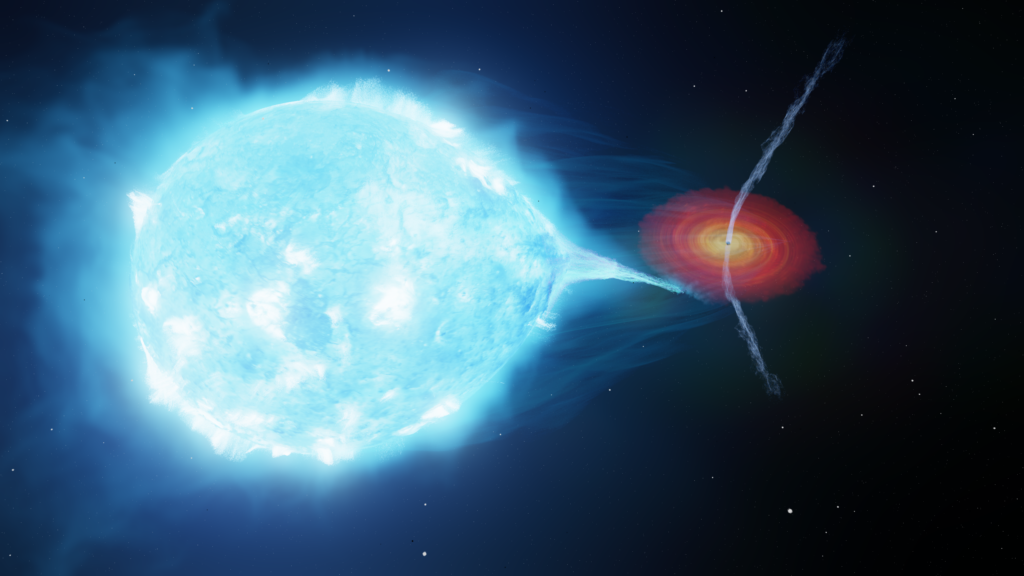
A Curtin-led team studied Cygnus X-1, the binary containing the first confirmed black hole and a supergiant companion. ICRAR describes its inferred jet power as equivalent to about 10,000 Suns, with material moving at roughly half the speed of light.
How a wind measures a jet
The companion’s wind bends the jets as the system orbits. Researchers combined radio images with a physical model of the interaction to infer power and launch speed. The study draws on 18 years of high-resolution observations, including detailed coverage of a 5.6-day orbit in 2016.
An “Earth-sized telescope”
This means widely separated radio antennas combined using very long baseline interferometry. The study used the Very Long Baseline Array and European VLBI Network. Their separation enables fine angular resolution; there is no single solid dish the size of Earth.
What the Sun comparison means
It compares an energy-transfer rate with the Sun’s luminosity. Jet power describes energy carried by the outflow, so it should not be read as 10,000 Suns’ worth of visible brightness or as a mass of 10,000 Suns.
What was observed, and what was inferred?
| Evidence | Role |
|---|---|
| Radio structure changes with orbital phase | Tracks the bending jets |
| Wind–jet interaction model | Connects bending to physical power and speed |
| About 10,000 solar luminosities | Rounded scale reported by the research institution |
“Instantaneous” distinguishes this estimate from power averaged over a surrounding nebula’s long history. It remains a model-based inference with uncertainties, rather than a direct meter placed inside the jet. The paper examines assumptions about wind properties and geometry.
Why it belongs in MKP
MKP perspective: This is a compelling example of measuring something indirectly through its interaction with its surroundings. The wind is more than an obstacle: it supplies information. It also illustrates why a vivid headline benefits from separating power, brightness, mass and speed.
Discussion prompts
How could a stronger wind imitate a weaker jet? What independent observations would help distinguish them? Why does increasing antenna separation improve resolution without creating an equally large collecting surface?
Discuss the discovery →Primary sources
- ICRAR: “Dancing jets” from black hole reveal their immense power — April 16, 2026.
- Prabu and colleagues. A jet bent by a stellar wind in the black hole X-ray binary Cygnus X-1. Nature Astronomy (2026). Author manuscript.