ASTRONAUT PHOTOGRAPHY • EARTH’S ATMOSPHERE • EVIDENCE
A Fireball Seen from the ISS Over West Africa
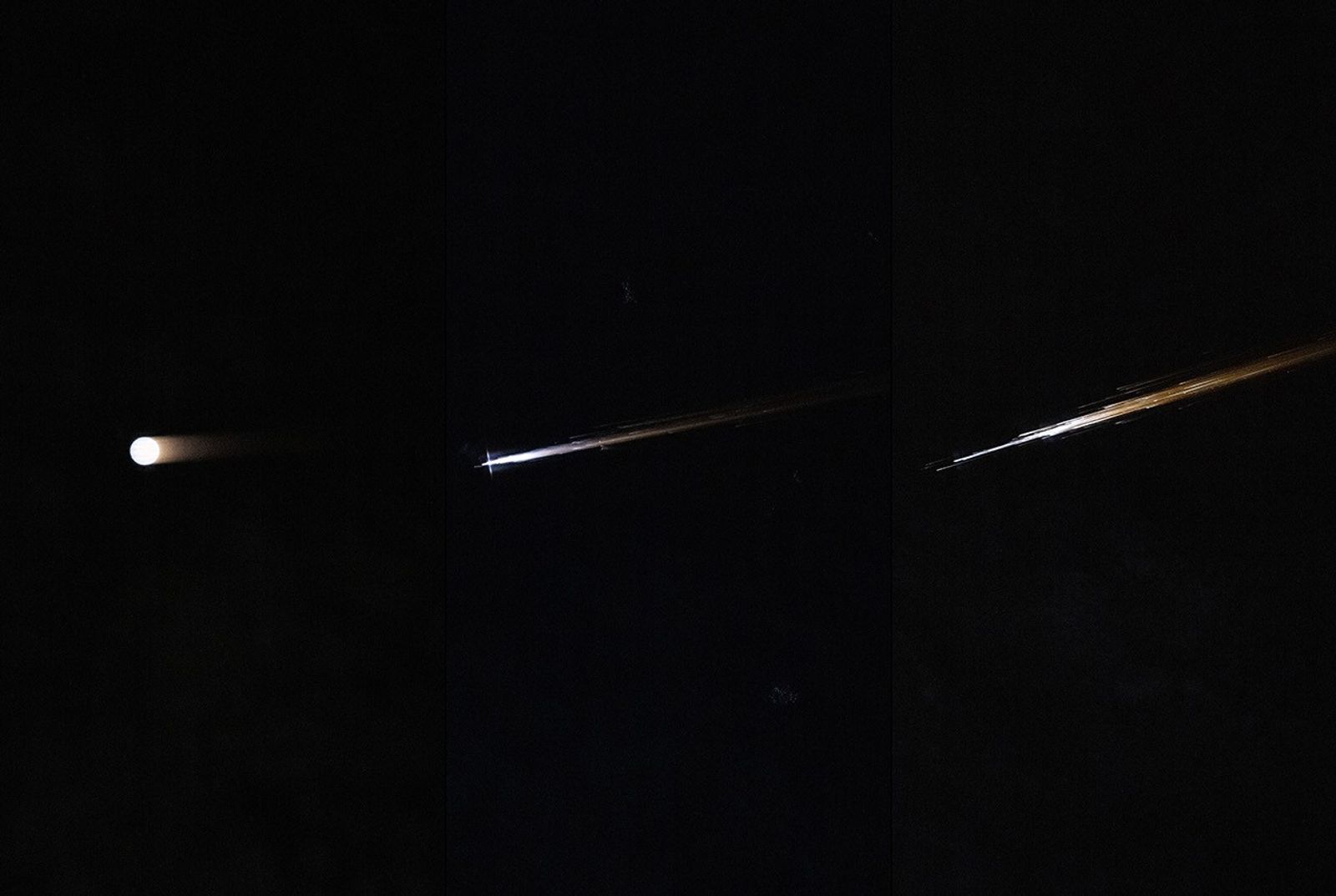
A striking sequence shows a bright object breaking apart—and leaves an identification question open.
ADDED NOVEMBER 1, 2026 • SIGHTING: APRIL 27, 2026 • NASA ACCOUNT: MAY 18, 2026
An unexpected sight while awaiting cargo
NASA astronaut Chris Williams reported the sighting while watching for an approaching cargo vehicle. NASA Earth Observatory places the observation over West Africa on April 27, 2026. October coverage revisits that event; it is not a newly observed October fireball.
What the photographs establish
The sequence records a luminous object and its fragmentation. NASA identifies the incoming vehicle as Progress 95, also called Progress MS-34, and explicitly says the event was not the cargo ship: it docked safely.
Possible explanations include a returning rocket body, a satellite or other human-made debris, or meteoric material. NASA’s account does not settle the identification. A Crew Earth Observations scientist noted that the camera’s precise pointing direction was needed to determine the source confidently.
Observation and explanation
MKP interpretation: A photograph can be compelling evidence of what was visible while leaving the cause uncertain. “Bright object breaking apart” describes the observation. Naming a specific satellite, rocket stage or natural object requires additional evidence.
The incoming cargo vehicle supplies context, but proximity in time is not enough to establish that its launch rocket caused the display.
Why this is worth studying
This sequence offers a useful exercise in scientific reasoning: start with what can be seen, propose competing explanations, and identify the measurements that could distinguish them. Keeping an uncertainty visible makes the account more informative.
Discussion questions
- What can the photographs alone tell you, and what remains unknown?
- How could timestamps, camera direction and independent observations help identify an object?
- What evidence would make you revise your preferred explanation?
Sources
- NASA Earth Observatory: Great Balls of Fire, May 18, 2026; updated May 21. Primary account, photographs and uncertainty assessment.
- Futura: the shared October 31, 2026 article, including Williams’s attribution.