MARS • METEORITES • PLANETARY GEOLOGY
Teghaza 001: A 4.1-Billion-Year Window into Mars
A rose-colored stone recovered in the Sahara preserves evidence from the Red Planet’s ancient crust.
ADDED NOVEMBER 2, 2026 • FOUND IN 2022 • RESEARCH UPDATE OCTOBER 29, 2026
From a desert find to an ancient planetary sample
The Meteoritical Bulletin records Teghaza 001 as a Martian meteorite found by Sahrawi meteorite hunters in northern Mali in September 2022. The recorded mass is 799 grams. Its fall was not observed: 2022 is the discovery year, not a known arrival date.
NASA’s October 29 report describes research led by Yang Liu showing that it formed at least about 4.1 billion years ago. It is among the most ancient Martian meteorites known. The headline age concerns its geological history on Mars, not how long it has been on Earth.
How minerals preserve time
Researchers analyzed tiny zircon crystals and other minerals using isotopic dating. NASA explains that the dating points to alteration by Martian water around 4.1 billion years ago, implying formation at that time or earlier. Interpreting a mineral’s age requires asking which event it records—crystallization, heating or later alteration.
Clues to early water
A separate June 2026 study in Science Advances measured water and hydrogen isotopes in calcium-phosphate minerals. It identified mixing between a relatively deuterium-poor magmatic source and a deuterium-rich component associated with ancient Martian water. The authors interpret this as magma interacting with crust previously altered by water, with implications for early atmospheric water loss.
Water evidence and life are different claims
These studies investigate rocks, water and planetary evolution. They do not report a detection of Martian organisms. A setting potentially compatible with life is a reason to investigate further, rather than evidence that life existed there.
Look closely at the sample
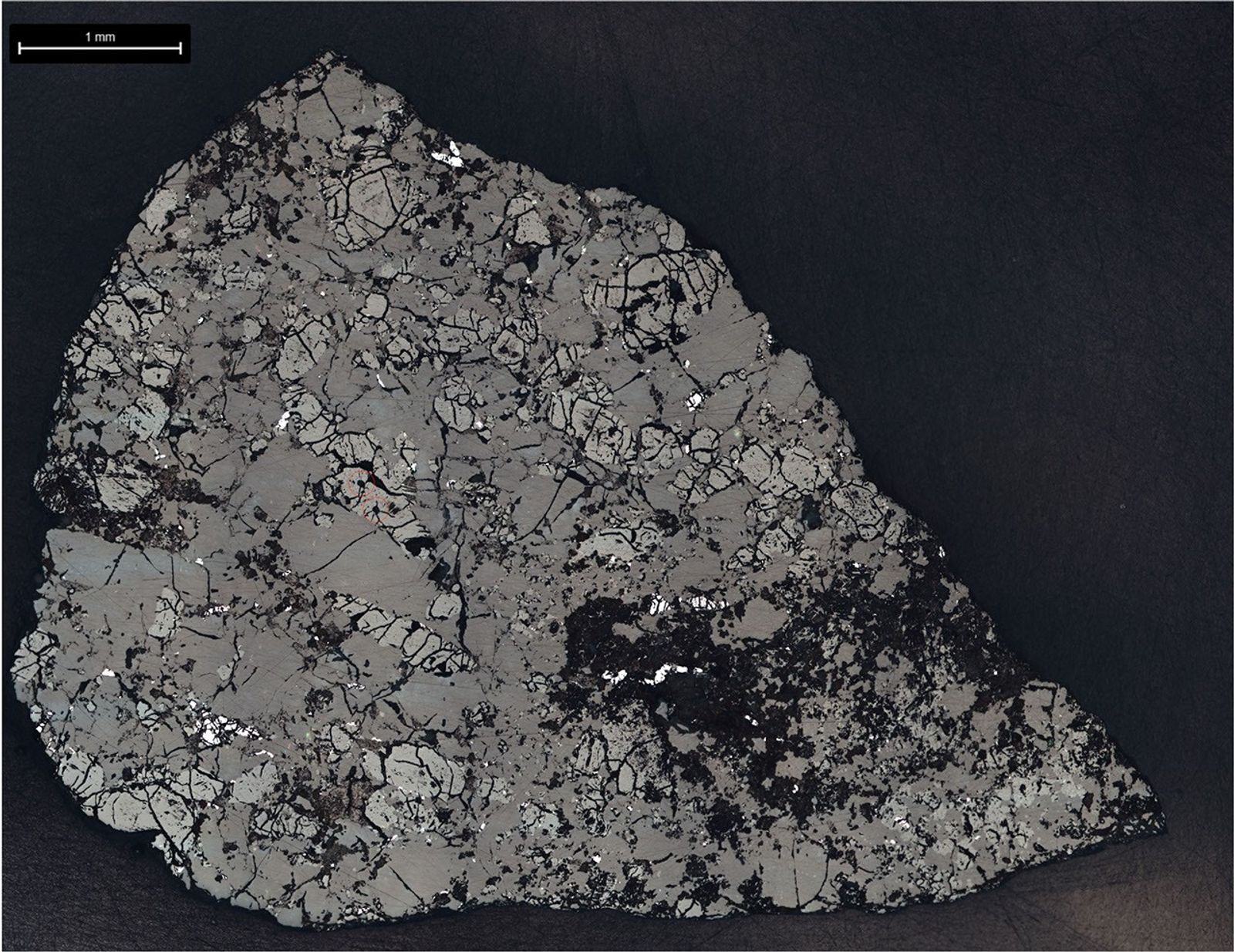
NASA’s photojournal explains that reflected-light images guide scientists toward minerals for further measurements. Its annotated version distinguishes several mineral types and notes that some fine-grained alteration minerals formed on Earth. Not every change in a meteorite necessarily happened on its parent planet.
Why this belongs in MKP
MKP interpretation: A small sample can connect chemistry, geological time and planetary exploration. Its value comes from the evidence preserved inside it and the ability to compare independent measurements.
Discussion questions
- How do a rock’s formation date, alteration date and discovery date differ?
- Why might scientists compare several mineral dating systems?
- What would you need to distinguish Martian alteration from changes after landing on Earth?
Primary sources
- NASA: Teghaza 001 research overview, October 29, 2026.
- Liu and colleagues: A Martian meteorite that formed ≳4.1 billion years ago samples Mars’ early crust and mantle, Science, 2026.
- Saper and colleagues: A Noachian hydrosphere component in the 4.1-Ga Martian meteorite Teghaza 001, Science Advances, June 2026. Open full text.
- Meteoritical Bulletin: official Teghaza 001 record.
- NASA Photojournal: slice, image credit and mineral descriptions.