SPACE • STAR FORMATION • WEBB
NGC 7129: A Stellar Nursery in Motion
Webb reveals how newborn stars transform their surroundings.
ADDED OCTOBER 26, 2026 • IMAGE RELEASE OCTOBER 6, 2026
What Webb sees
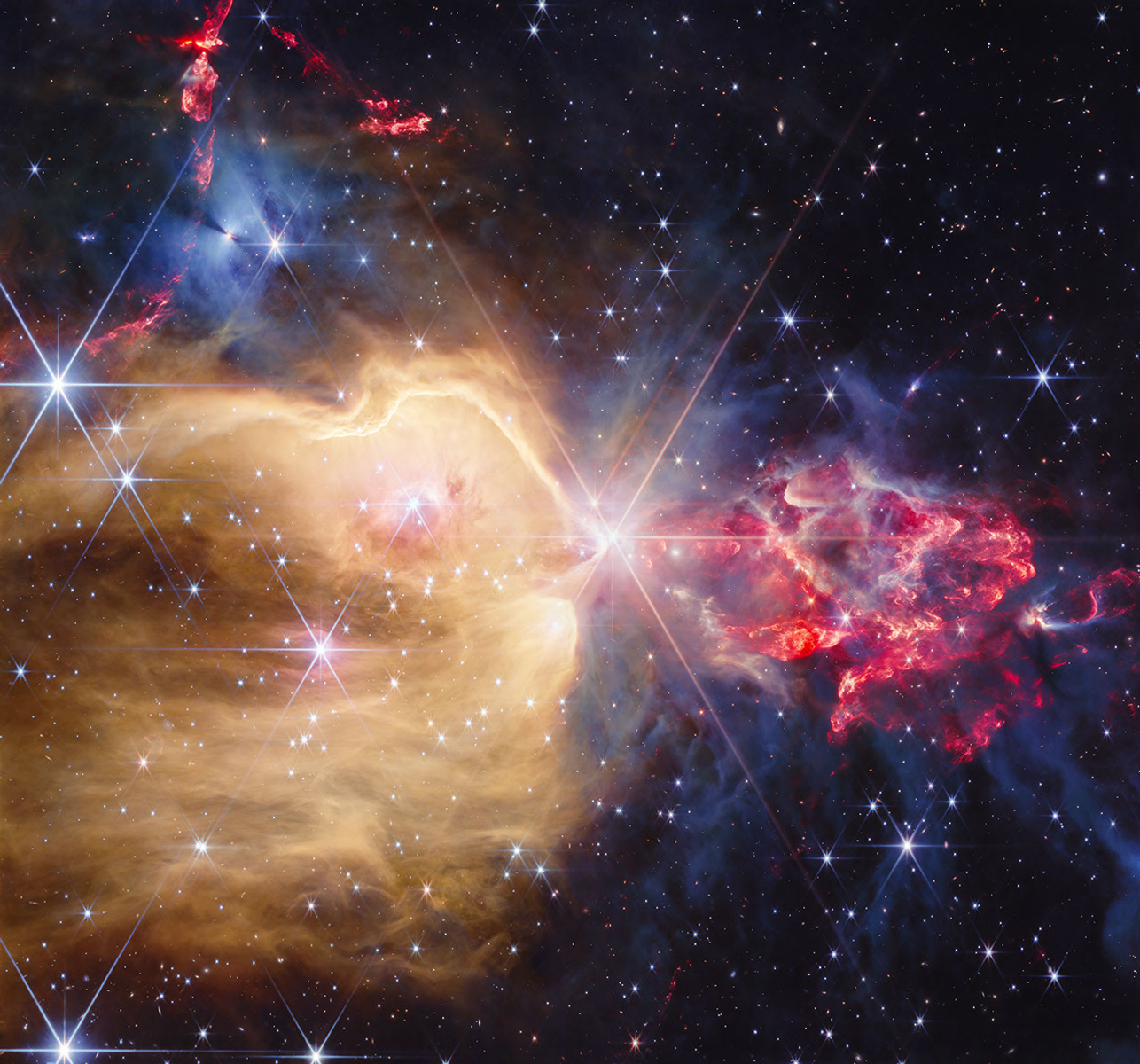
About 3,300 light-years away, NGC 7129 contains stars at different stages of formation. Webb’s infrared-sensitive NIRCam reveals objects obscured by dust. The bright central star, LkHα 234, is still contracting before sustained hydrogen fusion begins.
Stars reshape their birthplace
Outflows helped excavate the roughly 3.5-light-year golden cavity. Nearby stars contribute winds, while younger protostars remain embedded in denser material. These interactions erode clouds and can also compress gas, creating conditions for further star formation.
Reading the colors
This is an infrared composite with assigned visible colors. Gold represents hot atomic hydrogen; red traces cooler molecular hydrogen shocked by protostellar activity. The colors communicate physical information rather than an unaided human-eye view.
Why it matters
Webb’s detail helps astronomers investigate how forming stars affect surrounding gas and dust. A single image does not show the entire history unfolding; interpretation draws on observations and stellar physics.
Explore and discuss
How can an outflow both clear a cloud and help compress another part? What additional measurements would distinguish a plausible explanation from a demonstrated sequence of events?
Join the MKP discussion →